BADASAR CALBIYIK
AXIS (2026)
AXIS (2026)
Couldn't load pickup availability
AXIS (2026)
Artist: Badasar Calbiyik
Material: Solid concrete, lacquer, stainless steel frame
Technique: Multi-layered concrete structure with a 2D surface
Dimensions: 50 × 50 cm
Year of Creation: 2025
Uniqueness: One-of-a-kind
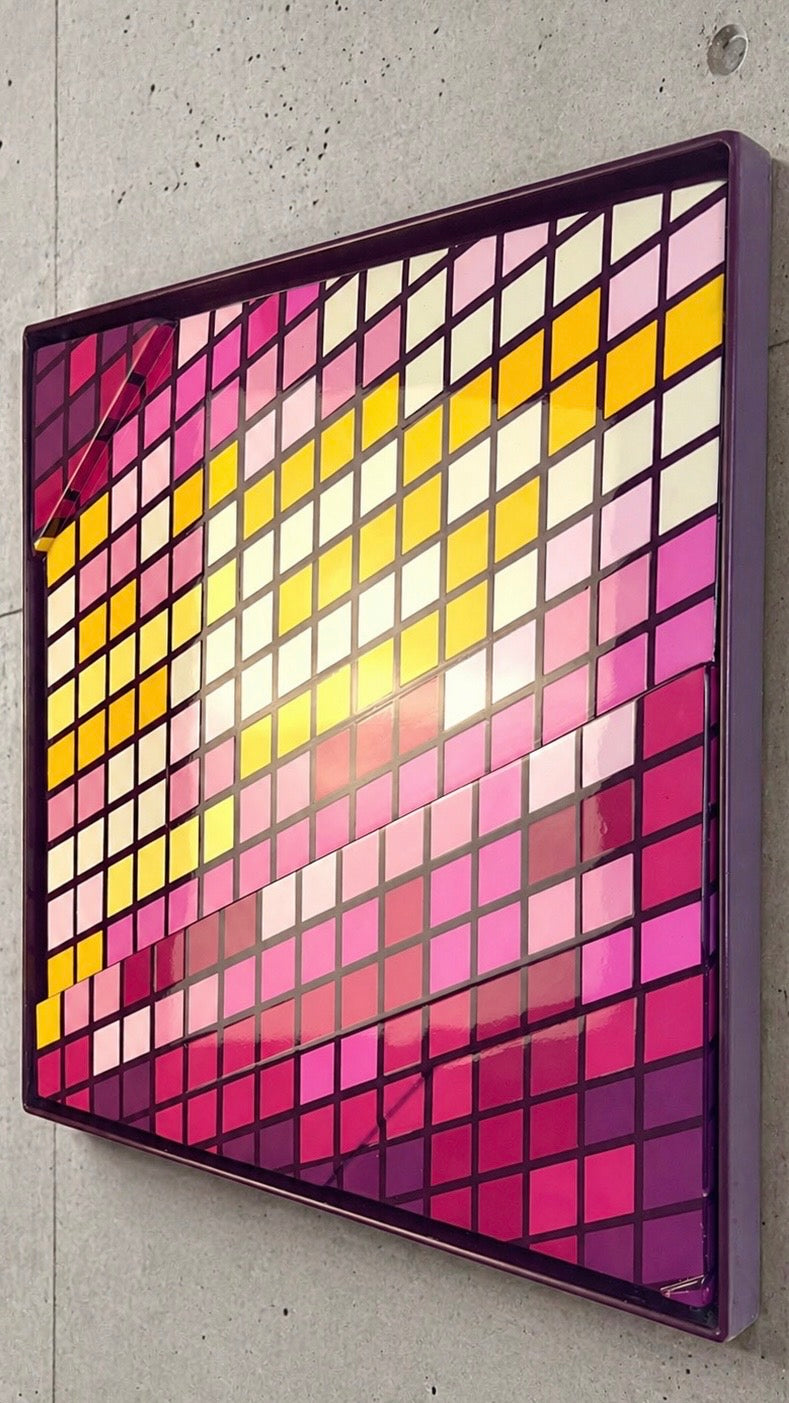
This concrete artwork explores light not as illumination, but as a structural phenomenon. Composed within a strict square format, the work is defined by a diagonal axis that organizes both color and perception. Along this axis, chromatic elements appear to shift gradually, suggesting movement, refraction, and the passage of light through space.
The surface is constructed from concrete, a material traditionally associated with mass, weight, and permanence. In contrast, the color transitions evoke immaterial qualities: luminosity, warmth, and spectral variation. This tension between material heaviness and optical lightness is central to the work. Light seems not to fall onto the surface, but to emerge from within it, as if embedded in the structure itself.
The diagonal grid functions as a visual system, reminiscent of wave propagation or interference patterns found in physics. Colors change incrementally, echoing the behavior of wavelengths as they refract or shift under changing conditions. The artwork does not depict light realistically; instead, it abstracts light into rhythm, direction, and density. Each geometric segment becomes a unit of energy, part of a larger luminous field.
The concrete background reinforces a sense of architectural space. It references urban environments where light interacts with rigid structures—walls, facades, and edges—creating fleeting moments of reflection and color. Here, light is stabilized and fixed into form, allowing the viewer to contemplate it beyond its transient nature.
Ultimately, the work invites a slowed perception. It asks the viewer to follow the axis, to observe how color behaves like light in motion, and to consider how structure can hold something as elusive as luminosity. The image becomes a study of balance: between order and shift, solidity and radiance, physics and perception.
Share